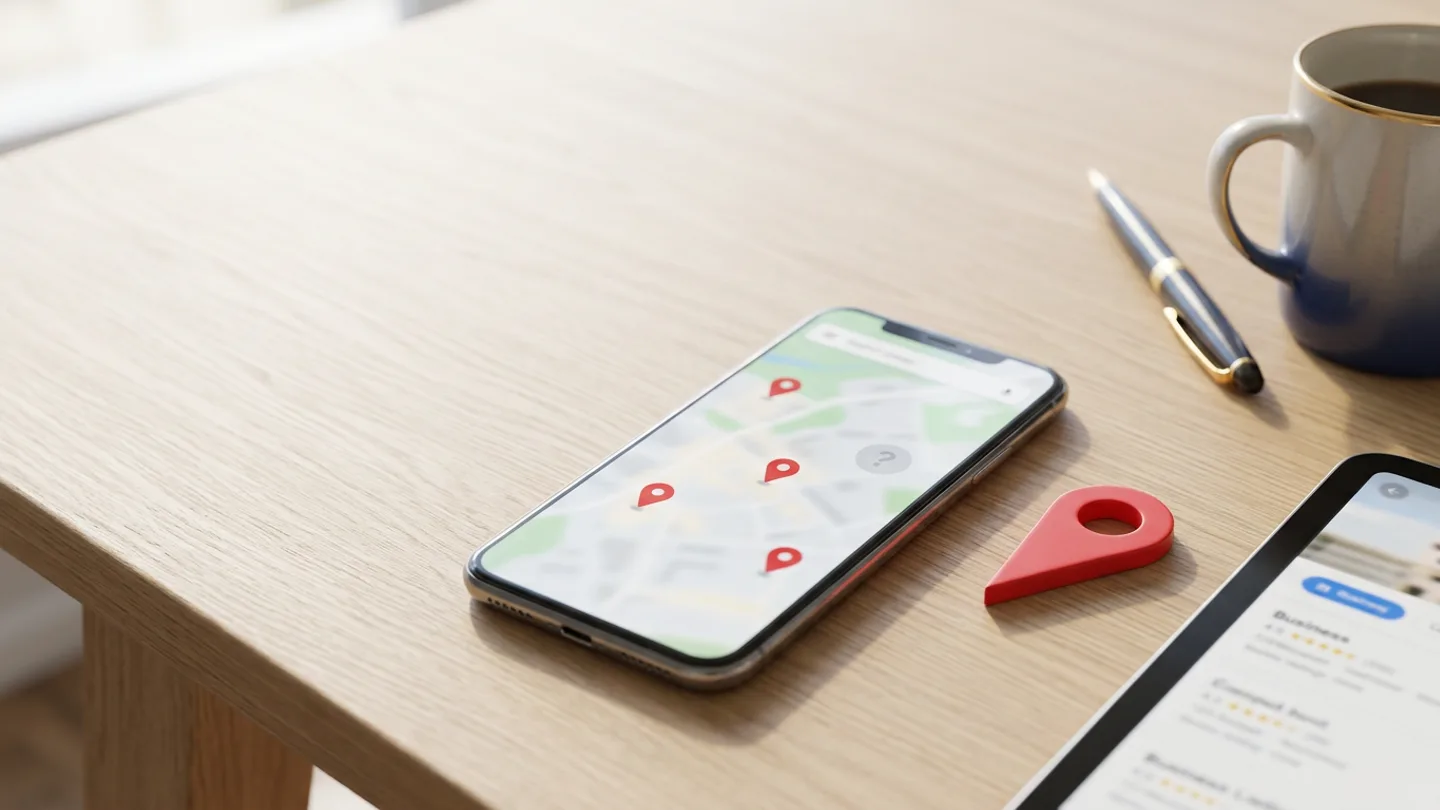
Not on Google Maps? Fixes That Work
Not on Google Maps or only for your name? Common causes include verification, categories, mismatched contact info, and distance, plus what to fix first on your site and Google Business Profile. Cincinnati & NKY.
You search for your business on your phone and the pin is missing. Or you only show up when someone types your exact name, while competitors own “near me” and city-plus-service searches. When that happens, most owners assume Google is “broken” or that they need a trick. Usually neither is true.
Why is my business not showing on Google Maps? In practice it comes down to a short list: your profile may not be verified or may be restricted, your category and services may not match what people search, your name and phone may be inconsistent online, or you may simply be farther from the searcher than stronger competitors. Maps visibility is structure and eligibility first, then relevance and trust.
Below is the order we use when a local owner asks why they are not showing on Google Maps. Fix the blockers first. Then tighten how clearly Google understands what you do and where you work, including on your website. If you want help with that alignment, our local SEO and Google Business Profile (/services/local-seo-discovery) work starts with discovery, not guesswork. For a focused profile sprint, see Google Business Profile optimization (/services/google-business-profile-optimization) .
Quick takeaways
- Unverified, suspended, or duplicate listings are common reasons you are invisible on Maps, fix profile status before anything else.
- Wrong primary category, incomplete services, or messy NAP (name, address, phone) makes Google less sure you match high-intent searches.
- Distance matters: you can be “fine” and still rank lower if the searcher is closer to competitors, relevance and prominence are where you push back.
- Your website and Google Business Profile should describe the same services and areas; when they drift apart, local relevance suffers.
- Steady reviews, photos, and responses help prominence, without stuffing keywords into your business name.
First checks: Is your Google Business Profile eligible and in good standing?
Google only shows businesses that meet its rules and complete verification. If you skip this step, nothing else you do will stick.
When someone asks why is my business not showing on Google Maps, we open their Business Profile manager first. Look for warnings, a missing verification badge, or a duplicate you forgot about from an old location. Those issues block everything downstream.
Creating a profile is not the same as finishing verification. Until Google confirms your business, you can look incomplete or unstable in Search and Maps. Google outlines verification options in its help center, postcard, phone, email, or video, depending on your situation. Start with Google’s verification guidance and finish whatever step is still open.
A suspended or duplicate listing can make it look like your business vanished overnight. Common problems include multiple profiles for the same location, misleading addresses, or patterns that violate policy. Google publishes an overview of Business Profile policies so you can see what triggers enforcement. If you are suspended, fix the underlying issue before you expect map visibility to return.
Your business name also has to match how customers know you in the real world. Google’s guidelines for representing your business are clear: do not pack extra keywords into your name to manipulate rankings. That tactic can backfire with a suspension.
Major profile edits can trigger review or re-verification. Google may need to confirm you still operate where you say you do. Updates also take time to spread through Google’s systems, so expect a few days of fluctuation after legitimate changes, not months of silence, but not instant stability either.
If you moved, update your site and key listings to the same address and phone. Mixed signals confuse both customers and Google. For more on timelines and what we include in builds, see our FAQ on websites, audits, and packages (/faq) .
Why is my business not showing on Google Maps for the searches I care about?
Once your profile is eligible, rankings still swing. Google’s local results lean on three ideas people summarize as relevance, distance, and prominence. Moz’s survey of local search ranking factors is a useful snapshot of what experienced local marketers watch year to year. You do not need every data point, just the mental model.
Relevance is whether Google believes you offer what the searcher typed. Distance is how far you are from the person or from the rough center of the area they searched. Prominence is how strong your reputation and footprint look online: reviews, links, mentions, and how people engage with your listing.
You cannot move your shop closer to every searcher. Search Engine Land’s guide to proximity in local search explains why “near me” results can favor businesses closer to the searcher, even when you believe you are the better choice. That is normal. Your job is to win on relevance and prominence where distance is fixed.
Your primary category is one of the strongest signals for what you should rank for. Pick the most accurate specific category, not the broadest bucket. Fill services with the phrases customers actually use. If your profile says one thing and your site says another, you dilute relevance.
Many businesses treat their website and Google Business Profile as separate projects. Google does not. When categories, services, and page structure line up, Google understands what you do and where you work. That is the same alignment work we use with local clients: match Google Business Profile services to your website structure so both reinforce each other.
Searches for your business name are easy: Google already connects the name to your listing. Generic or “near me” searches are competitive. They demand strong relevance (right category and services), reasonable proximity, and prominence (reviews, engagement, consistent listings). If you only win branded searches, you are usually weak on one of those three, not secretly penalized.
Ask yourself what a stranger would type before they know your name. If your profile and site do not clearly answer that job in the first few seconds, you are leaving those searches on the table.
Name, address, and phone consistency across the web
NAP stands for name, address, and phone. When those drift between your site, your Google Business Profile, Yelp, Facebook, and industry directories, Google sees noise. Customers see confusion. Both hurt.
Pick one official format for your business name (matching your real-world signage), one public phone, and one address or service-area description. Update the places people actually check. You do not need a hundred citations, you need agreement where it matters.
If you are fighting old addresses from a move, work the major listings first, then your contact page and footer. Small inconsistencies are enough to weaken local trust signals.
The same discipline applies to service-area businesses. If you hide your address but serve defined towns, say so clearly on your site with honest coverage pages, not fake “virtual offices” in every city. Google’s policies are strict about how locations and service areas are represented, and shortcuts often cause a suspension that answers “why is my business not showing on Google Maps?” with a hard stop.
How your website helps (or hurts) Maps visibility
Your website supports prominence and relevance. A slow, thin, or confusing site does not “cancel” a good profile, but it makes you a weaker answer than a competitor with clear service pages, fast loads, and obvious contact paths.
If visitors cannot tell what you do, where you work, or how to call in the first screen, they bounce. Google notices engagement patterns. Fixing structure, clear services, location cues, tap-to-call, usually matters more than a cosmetic refresh.
A website rebuild focused on speed and clarity (/services/website-rebuild) gives you pages that load fast on phones and answer the grunt-test questions: what you do, where you work, how to contact you.
We rebuilt structure for a Cincinnati-area record shop that already had strong reviews. Their site did not clearly support the product and service language people used in local searches, so discovery leaned too hard on people who already knew their name. After aligning categories and website structure with their listing, they strengthened visibility for searches like “record store Milford OH” and “vinyl records near Milford.” The lesson: your website should support your Google Business Profile instead of fighting it.
A website is not always mandatory for every business type in every market, but going without a strong site usually caps how competitive you look next to businesses that do. For most owners who care about calls and quotes, a simple, fast site is part of the local stack, not an optional brochure.
Browse local businesses we have helped with visibility and rebuilds (/work) if you want to see how structure changes show up in real projects.
Reviews, photos, and ongoing activity
Prominence is not magic. It is proof that real customers choose you. Steady reviews, fresh photos, completed services, and prompt replies signal an active business. Automated review replies can keep responses consistent when you are busy, as long as the tone still sounds human and grateful.
Photos matter more than owners expect. Interior shots, team photos, and finished work help a browser decide in seconds. They also reinforce that you are a real place people visit, not a shell listing. Pair visual updates with occasional Google posts about real offers or hours changes so the profile does not look abandoned.
If your basics are solid and you are still asking why is my business not showing on Google Maps for competitive terms, zoom out. Compare category fit, review velocity, and website clarity with the top three you see in the map results. The gap is usually obvious once you look without ego.
You will not fix Maps overnight. You can fix the order of operations: eligibility and policy, then relevance and consistent contact info, then site alignment, then prominence habits.
What to do next
If you are not showing on Google Maps the way you expect, start with verification and policy health. Then tighten your primary category and services, clean up your name, address, and phone everywhere they appear, and make sure your website repeats the same story. That is how Google builds confidence about what you do and who you serve.
When you are ready for hands-on help, profile setup, local structure, or a rebuild that supports discovery, start with local SEO and discovery (/services/local-seo-discovery) or reach out through get a quote (/get-a-quote) . We will tell you what is blocking visibility before we talk about build options.
Keep reading
Strong Maps visibility and a site that converts go together. When you are done tightening your profile, make sure your pages pass the five-second clarity test too.