Do I Need a Website If I Have a Google Business Profile?
Your Google Business Profile gets you on the map. Your site closes the sale. Here is when a profile alone works, when you still need a site, and how they should match. Cincinnati & NKY.
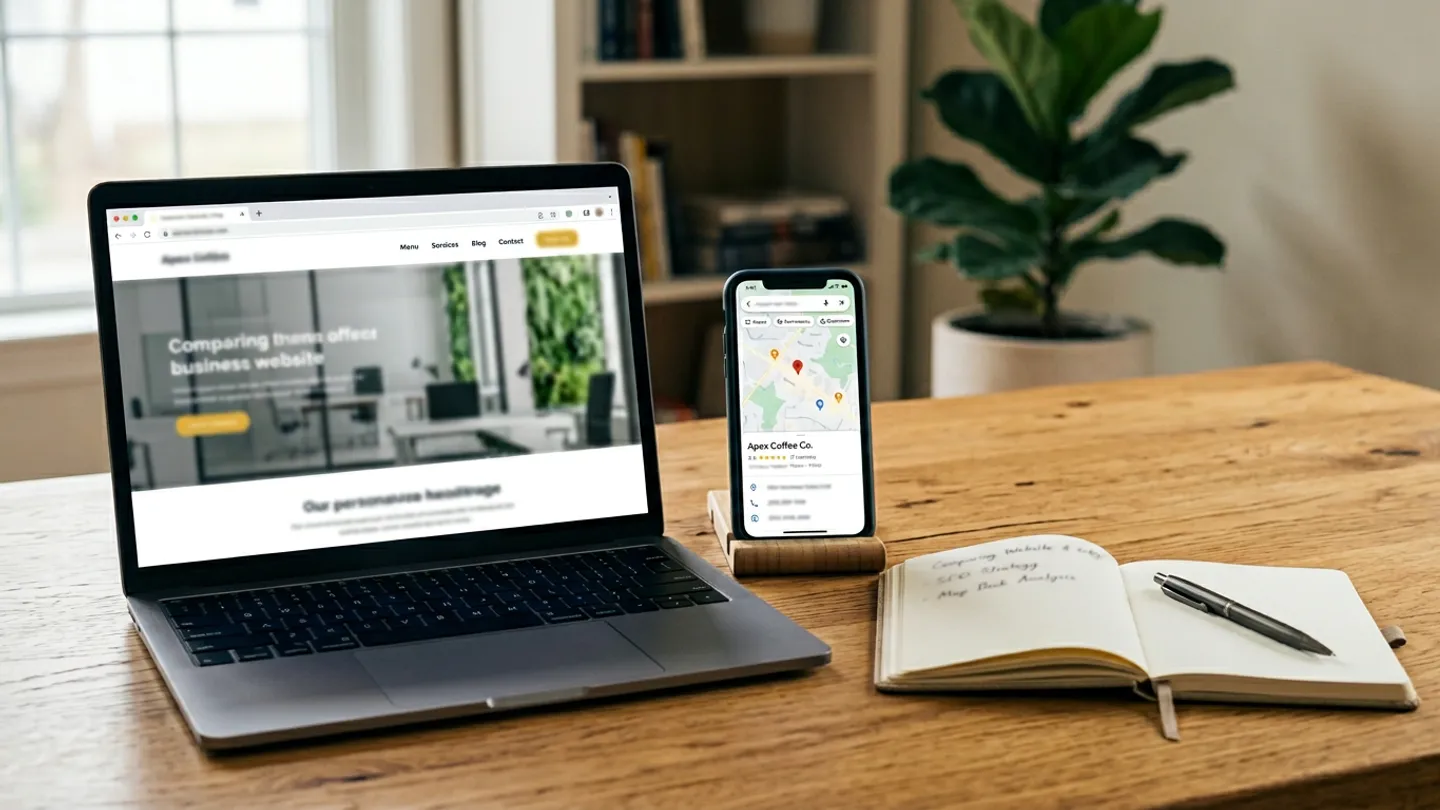
A Google Business Profile puts you on Google Search and Maps when people look for what you do nearby. A website is the place you control: offers, proof, forms, and speed. Most serious local businesses need both. The profile earns the glance. The site earns the call.
The confusion usually starts with time and budget. Owners hope the profile can replace a site because it feels faster to set up. Sometimes that works for a short season. Long term, you still need a site you own for depth, simple analytics, and brand story, especially if you run ads or serve customers who compare three quotes before they book.
This article is for Cincinnati and NKY operators who want a straight answer without jargon. If you already have both assets, skip to the section on alignment. If you are choosing where to spend next, read the tradeoffs with your actual customer path in mind.
Quick takeaways
- Use the profile for hours, reviews, directions, and quick answers.
- Use the site for depth, pricing context, portfolio, and lead capture you own.
- Keep name, services, and area language aligned so users and Google see one story.
- If you only have social, you rent the audience. A site is equity you control.
- Ads and email should point at pages you can test and improve, not only a social wall.
When a profile alone might be enough
Solo operators with a full calendar sometimes coast on Maps plus text messages. That can work until you need to hire, raise prices, or rank for more than your brand name. It also breaks the moment Google shifts how it ranks businesses or a competitor out-reviews you.
If you are testing demand, a verified profile and a simple one-page site with a clear call button beats a pretty Instagram grid that hides your phone number. The profile validates that you exist nearby. The page validates that you are worth the call.
Pop-up shops and side gigs sometimes run lean for a few months. Just know the ceiling. You cannot build rich service silos, long-form FAQs, or clean event landing pages inside the profile alone. Those jobs belong on a site when you are ready.
When you need a real site
You need a site when people compare options before they call: remodelers, dentists, attorneys, anything with a high ticket. You need it when you run ads and do not want to send traffic to a profile you do not fully control. You need it when you want clear pages per service or neighborhood without stuffing your business title with keywords.
Our new website (/services/new-website) builds are built around fast loads and a clear “what we do / where / how to hire us” path. If you already have a site that fights you, a rebuild (/services/website-rebuild) may cost less than another year of lost leads.
You also need a site when you care about stats beyond the basic numbers Google shows in your profile. Where do people drop off? Which service page converts? You cannot answer those questions well if every visit stays inside Google’s shell.
How they should match
Categories and services on the profile should line up with headings on your site. Hours and phone should match the footer. If the profile says you offer emergency service and the site never mentions it, you confuse buyers and dilute relevance.
For map-specific habits, read onOpenBlogReading?.("how-to-rank-in-google-maps-small-business", "post")} className="text-brand-gold underline bg-transparent border-0 p-0 cursor-pointer font-inherit text-left" > Google Maps ranking for small business . For regular search visibility issues, see onOpenBlogReading?.("why-is-my-website-not-showing-up-on-google", "post")} className="text-brand-gold underline bg-transparent border-0 p-0 cursor-pointer font-inherit text-left" > why a site might not show in Google .
Descriptions and on-page copy do not need to be identical word for word. They need to agree on facts and tone. Think of the profile as the trailer and the site as the full film. Same characters, same plot, more detail.
Trust, comparison shopping, and the second click
Many users find you on Maps, then open your site before they call. They want photos you chose, not only user uploads. They want a form that feels private. They want to see that you serve their specific problem, not a generic trade label.
If the site is slow or vague, they bounce back to the map and tap the next pin. That is why “profile only” strategies leak leads even when the map pin looks fine. The second click still has to close.
Measurement, forms, and pages you can improve
A website lets you run cleaner experiments. Change a headline, watch form starts, adjust again. On a profile alone, you are limited to the fields Google gives you. That is fine for basics. It is tight for depth.
Strong forms are short, mobile-friendly, and wired to notifications your team actually sees. Pair them with lead routing automation (/automations/leads-to-customer-list) when you are ready so submissions do not die in an inbox. The profile can still be the discovery layer. The site is where you finish the job.
If you fear maintenance, start small. One good homepage and three service pages beat fifteen stale microsites. Consistency beats sprawl.
What about social and third-party platforms?
Social profiles help discovery and personality. They are not a substitute for service pages Google can read, clean contact paths, or clear facts that help search and AI tools summarize you accurately. Use social to talk. Use your site to convert and measure.
If most of your leads come through one platform today, diversify before the platform changes your reach overnight. Owned email and owned web are boring insurance policies that pay off in bad months.
E-commerce, bookings, and deeper funnels
If you sell online or take deposits, your site carries checkout paths the profile cannot host cleanly. Even when you mostly book by phone, a site can explain packages, show galleries, and answer objections before someone dials. That pre-call education shortens conversations and lifts close rates.
Profiles can link to specific site pages for products or offers. Use that feature instead of cramming prices into the business name. Keep policy-safe fields clean and push detail to pages you control.
For teams that live on calendars, embed or link scheduling from the site, not only from the profile button. Redundant paths reduce friction when one surface glitches during a busy week.
Bottom line: keep the profile sharp for discovery. Build the site for depth, conversion, and assets you can iterate. Together they answer the split-second question on the map and the slower comparison happening in the next tab.
What to do next
Audit your profile with Google Business Profile optimization (/services/google-business-profile-optimization) . Line up your site through local SEO discovery (/services/local-seo-discovery) or start a new site (/services/new-website) . Questions on scope? Visit pricing (/pricing) or get a quote (/get-a-quote) . For profile copy specifics, see onOpenBlogReading?.("how-to-write-google-business-profile-description", "post")} className="text-brand-gold underline bg-transparent border-0 p-0 cursor-pointer font-inherit text-left" > how to write a Google Business Profile description .
Keep reading